






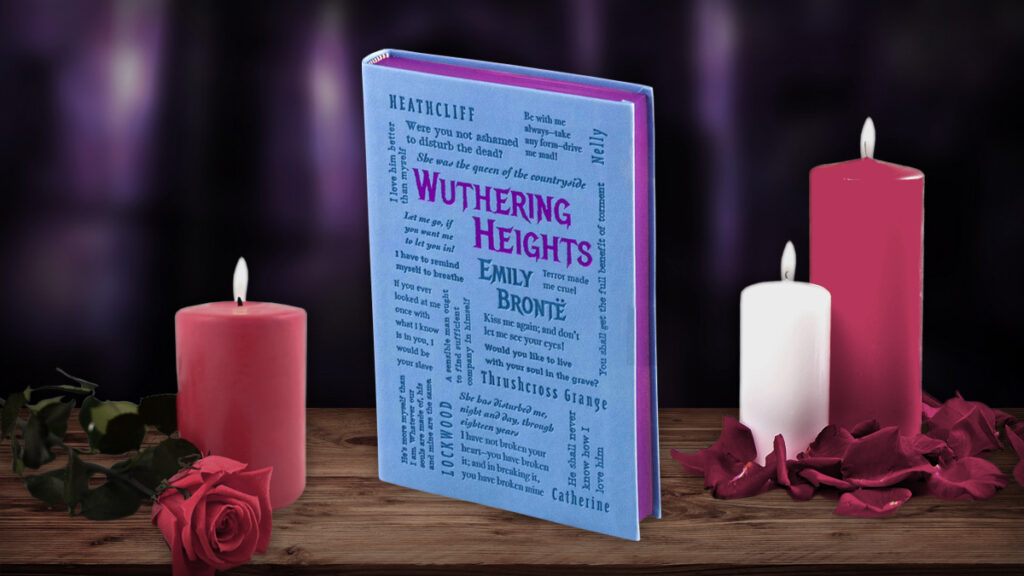
In retrospect, maybe Wuthering Heights wasn’t the best choice to kick off a new year of reading. Alongside political unrest, dangerous winter storms, and January’s never-ending gloominess, reading Emily Brontë’s one-and-only novel by no means lifted our spirits. Spoiler alert: This classic is not a love story.
And while the excitement and commentary on Emerald Fennell’s big-screen adaptation has reached a — pardon us — fever pitch, it would be a disservice to all our bookish friends if we failed to recognize the fact that it is definitely not all sunshine and rainbows on the Yorkshire Moors. In fact, we barely see any interpretation of a blue sky.
But alas, the casting, fashion and soundtrack of the new film has us all very intrigued so we will still be taking ourselves to the theater. After all, just like doomscrolling, we can’t resist a fictional emotional roller coaster. That said, if you haven’t read Wuthering Heights yet, or you just want to impress your bookish friends, here are five things to know about this Gothic Romance before you see the movie.

Greatest love story ever told? You be the judge.
No. 1: The Genre
Don’t let the term “romance” fool you, this genre is not for the weak. As hinted at in our intro, you will not find meet-cutes, emotional stability, or a happily ever after in the pages of Wuthering Heights. Instead, this classic is considered a Gothic Romance with a capital “R,” which means things can get pretty dark. Think high-stakes drama, a brooding male lead, forbidden love, accusations of insanity, a very moody setting, and perhaps even a ghost or two. Like traditional romance, there will be grand gestures, but they will most likely end in death, misery, or some kind of destruction.
No. 2: The Setting
In Brontë’s classic, an untamed, windswept landscape know as “the Moors” connects the Wuthering Heights estate to that of Thrushcross Grange. Both estates house the main characters who often travel back and forth across miles of uncultivated ground to visit one another. While the moors of the British Isles where Wuthering Heights takes place can sometimes serve as a calming refuge for its residents, it can also be a dangerous habitat due to uneven ground, wild weather, and even rumors of supernatural activity. Throughout Wuthering Heights, Brontë’s description of the moors mimics the behavior of her characters and is used to reflect Catherine and Heathcliff’s tumultuous relationship, as well as relationships between the main characters’ children and extended family.
No. 3: The Narrative Structure
When you first start to read Wuthering Heights, you may wonder who is the male narrator and what year are we in. That’s because the narrative structure of the novel is “a frame” (aka: a story within a story). In chapter one, we meet Mr. Lockwood who has just taken up residence at Thrushcross Grange and desires to meet his landlord, the infamous Heathcliff. Over the next few chapters, the reader discovers that the time of the beautiful Catherine Earnshaw has come and gone (at least, in the physical sense), and more than 15 years have past. After a supernatural encounter with the female protagonist in chapter four, Lockwood enlists former Wuthering Heights housekeeper Nelly Dean to spill the tea on the Heathcliff-Earnshaw-Linton love triangle and our story flashes back from there.
No. 4: The Characters
As lovers of literary classics, we were already big fans of Jacob Elordi in book adaptations (hello Frankenstein), but those who have been following the making of Fennell’s film from the beginning will remember the uproar over his casting as the brooding, vengeful outsider. That’s because in the book, Mr. Lockwood describes Heathcliff as “a dark-skinned gypsy in aspect, in dress and manners a gentleman.” We also learn that Mr. Earnshaw found young Heathcliff abandoned in Liverpool, a city historically associated with the slave trade in the early 1800s. While Heathcliff’s race is never truly specified, Brontë uses his character’s ambiguity to explore themes of class structure and racial exclusion throughout the novel. It will be interesting to see if these themes are addressed in the film.
What’s more, despite the Catherine-Heathcliff dominance of the current movie’s trailer, those new to Wuthering Heights should know that there is an entire second generation of Lintons, Earnshaws, and Heathcliffs whose inherited family trauma unfolds throughout the entirety of the second half of the book. Will we see this play out on the big screen? Inquiring minds want to know…
No. 5: First Impressions
Fun fact: Since the Brontë sisters used similar pseudonyms when publishing their works (Emily used “Ellis Bell,” while Charlotte used “Currer Bell”), many thought Wuthering Heights was written by the same author as Jane Eyre, which Charlotte released around the same time. Readers at the time were also outraged at the dark and dramatic themes of the novel and most certainly didn’t think it could be written by a women due to it’s shocking and vulgar storytelling. In fact, the classic didn’t become critically acclaimed until after Emily’s death, when her sister Charlotte revised it and revealed the author’s true identity.